The quick answer, and the catch
That planning answer is on most pages that rank for this question. What those pages skip is the thing that actually stops people. It is rarely the council. It is a 3 ft side passage, a row of wheelie bins, a pair of overhead cables and a lawn that turns to mud in November.
This guide covers the rules first, briefly and with the sources linked. Then it spends most of its length on delivery: how a static gets from a low-loader into a back garden, what your transporter will ask you, and why only about 1 in 11 static caravan transporters list crane lifting. For the wider picture on moving statics, see our guide to static caravan transport.
Does a static caravan in your garden need planning permission?
A static caravan in your garden generally does not need planning permission while its use stays incidental to the enjoyment of your house, according to the Planning Portal FAQ on keeping a static caravan, with older backing from a 1988 Hansard written answer on mobile homes in private gardens. A guest room, hobby room or extra family space is incidental. A separate, independent home is not, and needs permission.
The Planning Portal adds that a garden caravan should keep within the limits and conditions that apply to outbuildings. Councils apply the same incidental test. Cornwall Council’s enforcement guidance records a case where no permission was needed because the caravan was not a building and was being used for purposes incidental to the house.
The case people ask about most is a grown-up son or daughter moving in. If they sleep in the caravan but eat and wash in the house, that leans incidental. If they have their own kitchen, their own bathroom and their own daily routine, it starts to look like a separate planning unit. Do not guess on this one. Apply for a Lawful Development Certificate (LDC), which is a formal decision from the council that a use is lawful. Renting the caravan out is likely to change the planning position. GOV.UK’s guidance on when permission is required says a change of use needs permission only if it is material, and whether it is material is a matter of fact and degree decided case by case. So if you plan to let it, ask your local planning authority or apply for an LDC first.
If your house is a listed building or sits in a conservation area, speak to the local planning authority before anything else. And the caravan must sit within the garden of the house (its curtilage), not on a paddock or plot next door that you also own.
Whether a use is “incidental” is a matter of fact and degree. Nobody can promise you a blanket yes, including us.
What counts as a caravan? Size limits for a garden static
In England, a caravan is defined by section 29 of the Caravan Sites and Control of Development Act 1960, extended by section 13 of the Caravan Sites Act 1968 to cover twin units of no more than two sections that can be moved by road once assembled. Under the 2006 order (SI 2006/2374), the England limits are 20 m long, 6.8 m wide and 3.05 m for the height of the living space, measured inside.
Those figures are for England. Wales, Scotland and Northern Ireland have their own rules, so check locally if you live there.
The legal maximum width of 6.8 m is roughly 22 ft, which is far wider than any garden gate in the country. The legal limit is not your limit. Your gate is.
The definition also cuts the other way. As Shelter England’s summary of the mobile home definition explains, a twin unit has to be transportable by road when assembled. Something that cannot be moved in one piece, or two for a twin unit, risks being treated as a building rather than a caravan, and buildings bring a different set of planning rules.
Site licences, covenants and enforcement time limits
No caravan site licence is needed when the caravan’s use is incidental to enjoying a house within whose curtilage it stands, under paragraph 1 of the First Schedule to the Caravan Sites and Control of Development Act 1960. That exemption fits a garden static used as part of your home. Lose the incidental use and you lose the basis for the exemption. Separately, check your title deeds: a restrictive covenant can forbid caravans even where planning allows one.
Do not rely on the “4-year rule” you will still read on dealer pages. In England, a single 10-year limit for enforcement now applies to all breaches of planning control that began on or after 25 April 2024, under the Levelling-up and Regeneration Act 2023 as brought into force by SI 2024/452. The government’s summary of the enforcement changes sets out the change.
The old 4-year limit applied to turning a building into a separate home, and a caravan is generally not a building, so it was never a safe bet for a garden static. Wales keeps its 4-year limit for buildings. If you want certainty, get an LDC rather than waiting out a clock.
On council tax, a caravan used as someone’s separate main home may be banded separately, so ask your council or the Valuation Office Agency.
Delivering a static caravan to a house: can it get into your garden?
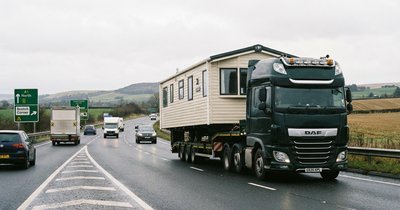
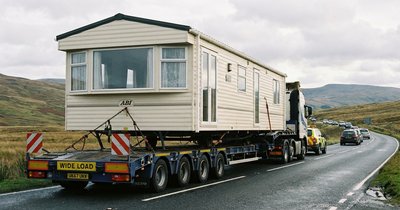
Delivering a static caravan to a house happens in one of two ways. The caravan arrives on a low-loader, then it is either towed or winched on its own chassis into the garden, or lifted over the obstacles by a crane or HIAB (a lorry-mounted hydraulic crane). Our guide on how to move a static caravan gives standard widths of 10 ft, 12 ft and 13 to 15 ft, so a tow-in needs a clear route at least as wide as your caravan from the road to the pad. If you don’t have one, the job becomes a lift, and only 49 of the 534 static caravan transporters in our database list crane or HIAB lifting.
Before a transporter can price your job, they will want answers to the questions below. Get them now, with a tape measure and a phone camera.
Getting the caravan to the garden
- Access width. Check your caravan’s width against the 10 ft, 12 ft and 13 to 15 ft standard widths. Measure between the gate posts, then find the narrowest point of the whole route: side passage, downpipes, bins, the car on the drive.
- Lorry position. The same guide puts typical lengths at 28 to 40 ft. Where can a low-loader carrying one stop, and can it turn or reverse out? Note how long your road frontage is and whether the street is lined with parked cars.
- Overhead lines and trees. Power and phone cables across the route or over the garden matter for a tow-in and even more for a lift. So do overhanging branches.
Getting it onto the pad
- Ground and slope. A wet lawn will not carry a heavy load, and a slope makes winching harder. Say if the ground is soft or uneven.
- Crane stand and reach. If it has to be lifted, where could a crane stand, and how far from that spot to the pad?
- Base ready. A level base or pad should be finished before delivery day, not after.
- Services planned. Know where water, drainage and electricity will connect. A full set of separate mains connections can make a council more likely to treat the caravan as a separate home, so mention them if you apply for an LDC.
Measure before you buy or book, not after. A caravan that cannot reach the pad is the expensive mistake in this whole process, because by then you own it, it has been delivered somewhere, and the only way forward is a lift you did not budget for.
There is no authoritative guide to garden delivery of static caravans, so the closest evidence comes from neighbouring trades. A garden-building supplier, Summer Garden Buildings, lifts cabins over walls, fences and hedges with a truck-mounted crane and warns that trees and overhead cables can stop the unload happening where you want it. Checkatrade’s crane hire guide makes the same point about narrow access and overhead obstructions changing which crane is needed. Neither is about caravans, but the same obstacles stop a static caravan lift.
For caravans specifically, our guide on how to move a static caravan sets out the norm: crane hire is quoted as a separate line item and has to be booked in advance, so ask for it in writing before you accept the haulage quote. Whether a crane is needed at all comes down to the photos and measurements you give the transporter.
Ready with your measurements? Post the job with photos and let transporters tell you how they would get it in.
Crane or tow-in? Finding a transporter who can do a garden job
Of 534 static caravan transporters in the TransportQuoteCompare UK transporter database, 49 (about 9%, or roughly 1 in 11) list crane or HIAB lifting on their listings or websites, counted on 23 November 2026. If your caravan has to go over a fence, a wall or the house itself, the pool of firms that can take the job shrinks sharply.
That is why you tell transporters up front. Send photos of the gate, the side passage, the garden and any overhead lines, plus your measurements and the caravan’s length and width. Measurements and photos help transporters assess the job properly, which can make the quotes you receive more accurate and less likely to grow on the day.
TransportQuoteCompare is a marketplace. We do not move or crane caravans ourselves; transporters see your job and quote on it. Our static caravan transport page explains how that works. For budgets, our static caravan transport cost guide breaks down the typical £300 to £2,500+ range by distance and width, with crane hire quoted as its own line.
Method: we counted transporters tagged static caravan in our UK transporter database whose listings or websites mention crane or HIAB. A mention means the firm lists the capability; it is not a check of their equipment, certification or insurance. Counted 23 November 2026.
Quick answers: sons, driveways and delivery costs
Can my son live in a static caravan in my garden?
Possibly. The test is whether he still lives as part of your household. Get a Lawful Development Certificate before he moves in, not after a neighbour complains.
Can I put a static caravan on my driveway?
Possibly, but a front driveway is harder than a back garden. The Planning Portal says garden caravans should keep to the limits for outbuildings, and those generally rule out the land in front of your house, so ask your council before you book delivery. Access is usually the easier part, because the low-loader can often get close from the road.
How much does it cost to deliver a static caravan to a house?
It depends on distance, width and access, and any crane is priced separately. Our cost guide has the full breakdown.
Measure first, then ask for quotes
Planning is usually the easier half: confirm the use with your council, and get a Lawful Development Certificate if you want it in writing. Access is the half that costs money if you get it wrong. Measure the route from road to pad, photograph the gate, the side passage and any overhead cables, and post the job with those photos so transporters who can handle a lift can quote properly. General information, not legal advice; check with your local planning authority.
Get free quotes