Low Loader Transport UK: Costs & When You Need One
Key takeaways
- “Low loader” covers everything from an £85/day Luton-body van to a 60-tonne multi-axle trailer with a police escort. Identify your tier before you compare prices.
- Many buyers searching for a low loader actually need a beavertail. If the load self-drives and weighs under about 15 tonnes, a beavertail costs less.
- Heavy haulage artic rates run roughly £2.00–£2.75 per mile, with minimum job charges of £300–£500 that blunt the saving on short moves.
- A load becomes an abnormal load only above 44 tonnes, 2.9m wide, 18.65m long, or 4.95m high. Plenty of low loader jobs stay within normal limits and need no permit.
- Standard haulier liability is capped at £1,300 per tonne from January 2026, often far below the value of the plant being moved. Confirm cover in writing.
Ask five hauliers for a “low loader” quote and you might get five wildly different vehicles, from a Luton-body transit van to a 60-tonne multi-axle rig with a police escort. Before you can compare prices, you need to know which one you actually need.
That gap is why so many buyers get burned. Someone moving a 6-tonne mini digger is pricing the same word as someone moving a tracked excavator that triggers abnormal load notifications, and the cost difference between those two jobs runs from about £100 a day to well over £10,000 for a single complex move. Get the vehicle type wrong and you either overpay or waste days chasing the wrong haulier.
This guide fixes that. You will get the five types of low loader explained plainly, a three-question test to decide whether you even need one, real UK cost ranges across four tiers, the abnormal load rules in language that is not written for lawyers, and a clear way to compare quotes so you find the competitive rate instead of accepting the first number you hear.
What is a low loader? The types, explained
A low loader is built around one defining feature: two drops in the deck height that create a lower-than-standard central well. That well lets you carry taller and heavier loads while staying inside legal height limits, which is exactly why tracked plant and industrial machinery default to this trailer rather than a flatbed.
The word covers five distinct vehicles, in ascending order of scale:
- Low loader van (Luton): A transit-sized van with a lowered loading deck. Furniture removal, retail deliveries, small plant. Self-drive hire runs £85–£155/day, or from £110/day plus VAT for a Luton body. This is the “low loader” most domestic and small business searchers actually mean.
- Rigid HGV low loader: A rigid lorry with a low-loading body, carrying small to medium plant up to around 20 tonnes. The workhorse for delivering compact excavators, telehandlers, and forklifts.
- Artic (semi) low loader: An articulated unit plus a specialist trailer, with 30–60 tonnes of payload. The most common heavy haulage vehicle, fitted with hydraulic ramps for drive-on loading.
- Extendable low loader: The trailer stretches in length to carry exceptionally long loads such as wind turbine blades and bridge beams, extending to 40m and beyond.
- Modular trailer / SPMT: Self-propelled multi-axle transporters for 100-tonne-plus lifts. A different product and cost bracket entirely, out of scope for most buyers.
Hold onto one distinction above all others: the low loader van is a completely different product category from the heavy haulage trailer. Payloads across the range run from 6 tonnes at the small end to 150 tonnes gross at the specialist end. Confuse the two and every cost figure you read will mislead you.
Once you know the types, the real question becomes whether your load actually needs a low loader at all, or whether a beavertail or flatbed would do the job for less.
Low loader, flatbed, or beavertail: which do you actually need?
This is the question that saves the most money, and almost nobody answers it before you call. Plenty of buyers searching for a low loader actually need a beavertail, and they end up paying for low-deck capability they will never use. Three trailers cover most jobs, and the difference between them comes down to height and weight.
Flatbed. A flat deck at standard height, roughly 1.3–1.4m off the ground. Fine for loads that are wide or long but not tall. The catch is total height: deck plus load should not exceed about 4.3m, so a flatbed cannot legally carry tall tracked plant without breaching the limit.
Beavertail. A standard-height main deck with a sloped rear and loading ramps that drop to ground level. Best for small to medium plant that can self-drive up the ramps, such as mini diggers and compact rollers. It is cheaper than a full low loader, but the load section still sits at about 1.3m, so height remains the constraint.
Low loader. The deck sits 0.8–1.0m from the ground instead of 1.3–1.4m. That lower deck is what lets you carry taller, heavier loads, and it is required when the loaded height on a flatbed would exceed roughly 4.2–4.3m, or when weight runs past about 18–20 tonnes on a rigid or 30–35 tonnes on an artic.
Three questions settle it:
- Will total height (load plus deck) exceed 4.2m on a flatbed? If yes, you need a low loader.
- Can the load self-drive up ramps and weigh under about 15 tonnes? A beavertail will do.
- Does the load exceed 30 tonnes or need ground-level loading? You are into artic low loader territory.
The distinction is real money. A 6-tonne mini digger rides happily on a beavertail. A 20-tonne tracked excavator needs the low deck, the heavier trailer, and the higher rate that comes with both. Pricing the excavator job as if a beavertail could do it is how buyers end up with quotes that fall apart on the day.
What loads typically need a low loader
Most buyers arrive here because they have a specific piece of kit to move. Seeing it listed is the fastest way to confirm you are in the right place.
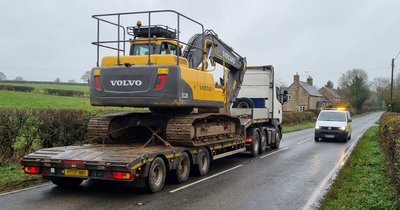
Construction plant is the bulk of the work: tracked excavators from 5 tonnes to 100 tonnes and beyond, bulldozers, road rollers whose height rules out a flatbed, crawler cranes, concrete pumps, and road planers. Agricultural machinery covers combine harvesters, which are wide and tall enough to count as abnormal loads almost every time, large tractors with attachments, and self-propelled sprayers.
Industrial equipment tends to be heavy and non-divisible: CNC machines and presses, transformers and switchgear, pressure vessels, and boilers. Infrastructure work brings modular and portable buildings, bridge beams, precast concrete elements, and wind turbine nacelles and tower sections, the kind of loads that move on specialist machinery transport.
One honest caveat. Some loads people assume need a low loader do not. Small static caravans and light agricultural trailers often travel fine on a specialist trailer or even a flatbed. Before you pay low loader rates, check that the height and weight actually demand it.
Now for the question every buyer came here to answer: what does it cost?
Low loader transport costs UK: a four-tier guide
Most cost guides list the factors and then dodge the figures. Here are the actual ranges, with their sources, so you can put a number against your job before you ring anyone. Prices fall into four tiers, and which tier you are in matters more than the mileage.
One framing point first. Low loader pricing is tier-based, not simply per-mile. A minimum job charge means a 50-mile move can cost almost as much as a 150-mile move once you are in Tier 2 and above. Distance matters, but it is not the whole story.
| Tier | Vehicle | Typical cost | Best for |
|---|---|---|---|
| 1. Van hire (DIY) | Luton low loader van | £85–£155/day self-drive | Furniture, small plant, retail |
| 2. Small–medium plant | Rigid HGV, up to ~20t | £1–£3/mile all-in | Mini excavators, telehandlers, forklifts |
| 3. Heavy haulage artic | Artic low loader, 30–60t | £2.00–£2.75/mile | Large excavators, cranes, heavy rollers |
| 4. Abnormal load | STGO / multi-axle | £1,000–£20,000+ per job | Over 44t, 2.9m wide, or 4.95m high |
Tier 1, van hire. Self-drive Luton low loaders run £85–£155/day, or from £110/day plus VAT in London. No haulier required, deposit typically £250. This is the cheapest route for furniture, retail deliveries, and the smallest plant, and it is what most domestic searchers actually need.
Tier 2, small to medium plant. For routine moves of a mini excavator, telehandler, or forklift, expect £1–£3 per mile all-in within normal load parameters. A 200-mile round trip lands at roughly £200–£600, and same-day or next-day availability is common.
Tier 3, heavy haulage artic. Market rates sit around £2.00/mile for an 18-tonne HGV, £2.25/mile at 26 tonnes, and £2.75/mile for a 44-tonne unit up to 200 miles. Minimum job charges of £300–£500 apply regardless of distance, and equipment alone starts from £300/day with the operator on top. This is where most heavy plant buyers actually sit, so budget from these numbers rather than the van rates above.
Tier 4, abnormal load. Once a load exceeds 44 tonnes, 2.9m wide, or 4.95m high, the costs change shape. A police escort can add £500–£3,000 or more per day per escort vehicle, multi-axle trailer hire is price-on-application, and complex multi-day movements run from £1,000 to £20,000 and beyond. This is firmly get-three-quotes territory.
Seven things move the final number:
- Weight and dimensions set the vehicle spec, which is the single biggest lever.
- Distance counts, but minimum job charges flatten the saving on short moves.
- Site access at both ends, where tight gates, soft ground, or low cables can force a bigger vehicle or a crane-off.
- Timing, since overnight and weekend moves carry premiums.
- Abnormal load status, which adds permit admin and, above the thresholds, escort costs.
- Insurance cover above the standard liability cap, for high-value plant.
- Extras such as a HIAB crane-off, a machine fitter, or a route survey.
The first three decide most quotes. Get them right in your brief and the numbers you receive will actually be comparable.
Before any haulier can quote a Tier 3 or Tier 4 move properly, they need to know whether the job triggers UK abnormal load rules. So do you.
UK abnormal load rules: what triggers them and what to expect
The government sources read like legislation and the trade sites talk to operators, not buyers. Here is the version you actually need.
A load becomes an abnormal load (legally a Special Types vehicle) the moment it exceeds any one of four thresholds: more than 2.9m wide, more than 18.65m long as a combination, more than 44 tonnes gross, or more than 4.95m high. Stay inside all four and no abnormal load notification is needed.
Above 44 tonnes you enter the STGO categories (Special Types General Order). Category 1 covers 44–80 tonnes and needs two clear working days’ notice to highways, plus police if the load is over 3.0m wide. Category 2 covers 80–150 tonnes, with two working days’ notice and a possible police escort. Category 3 is 150 tonnes and up, requiring five clear working days’ notice, a mandatory police escort, and sometimes a VR1 application to the DfT.
The mechanism behind all of this is ESDAL, the government’s online portal for abnormal loads. Hauliers use it to plan routes, check bridge restrictions automatically, and notify every highway authority on the way. You do not need to touch ESDAL yourself. A reputable haulier builds that admin time into the quote, and if a load clearly triggers abnormal status and the haulier never mentions ESDAL, treat it as a red flag.
The point buyers miss most often: not every low loader job is an abnormal load. A 25-tonne excavator on a 44-tonne artic low loader, within normal width, stays inside legal limits with no permits at all. Only loads that cross one of the four thresholds need notification.
How to compare low loader quotes (and what to tell a haulier)
Knowing your tier and your regulatory position is worth nothing if the quotes you collect are not comparable. The fix is preparation.
Have your load details exact, not approximate: height, width, length, and weight to the nearest sensible figure. Describe the access at both ends honestly, including road width, overhead clearance, and surface type. State the delivery date or window you need, whether the load is self-propelled or needs craning off, and any permits already in place. That access detail matters more than buyers expect, because 18% of heavy transport delays trace back to site access problems that only emerge on arrival. Give a precise postcode and flag any gate widths, overhead cables, or soft ground, or you will get a wrong quote and a worse surprise on the day.
Then get at least three quotes. For Tier 3 and above, regional hauliers price on their fleet position that week. An operator with a trailer returning empty near your collection point can quote 30–40% under one running out of position, and the only way to find that haulier is to ask several at once. A comparison platform lets multiple verified operators see the same job and compete, instead of you ringing round and re-explaining the load five times.
Insurance is the detail buyers skip and regret. Standard haulier liability is capped at £1,300 per tonne from January 2026, which is frequently well below the replacement value of high-value plant or industrial machinery. A six-figure machine on a 25-tonne basis is covered for around £32,500 by default, nowhere near enough. Ask the haulier to declare the value, check whether specialist all-risks cover is included or costs a premium, and get the figure confirmed in writing before you accept anything.
You do not need to memorise any of this. You need to apply it once, for the load in front of you right now. Post the job on TransportQuoteCompare, describe the load and the two sites, and verified low loader operators across the UK compete for the work. You compare prices, profiles, and insurance side by side, then pick the haulier that fits.
Need a vehicle moved on a low loader? Compare car and vehicle transport quotes from verified UK carriers.
Need a Transport Quote?
Compare quotes from verified UK transporters. Free and takes under 2 minutes.
Get Free Quotes