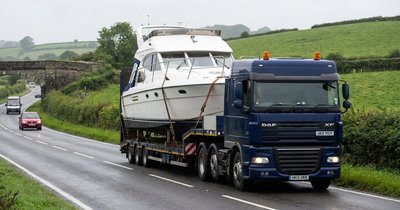
How Much to Transport a Boat? UK Prices by Boat Type
Quick answer: how much to transport a boat in the UK
In short
How much to transport a boat in the UK for a 100-mile road move: roughly £100 to £250 for a small boat already on a trailer, from £650 to £1,350 for a 20 to 30 ft cruiser in a cradle, and £800 to £1,600+ for a keelboat over 40 ft, according to TransportQuoteCompare’s full guide to boat transport costs and logistics. These are typical ranges, checked October 2026. For bigger boats, read them as a floor.
The per-mile tables never mention the two things that decide the bill. The first is how the boat travels: on its own road trailer, or in a cradle that needs a crane at each end. The second is how wide it is. Get those two right and the mileage is the easy part.
How much to transport a boat, by boat type
The cost to move a boat by road, 100 miles, ranges from about £100 for a dinghy or RIB already on its own trailer to £1,600 or more for a keelboat over 40 ft, according to the per-mile ranges in TransportQuoteCompare’s boat transport guide. The gap comes from crane lifts: own-trailer jobs need none, cradled boats need two.
| Boat type | How it travels | Lifts | Typical 100-mile job |
|---|---|---|---|
| Dinghy, kayak, jet ski or small RIB, under 20 ft (if towed on its own trailer) | Towed, or on the haulier’s trailer | 0 | £100 to £250 |
| Under 20 ft, no road trailer | Flatbed and cradle | 2 | £500 to £1,250 |
| Trailer-sailer or day cruiser, 20 to 30 ft | Cradle on a low-loader | 2 | £650 to £1,350+ |
| Motor cruiser, 30 to 40 ft | Cradle on a low-loader | 2 | £750 to £1,400+, plus wide-load costs if over 3 m |
| Narrowboat, 30 to 70 ft | Low-loader | 2 | £600 to £1,400 |
| Keelboat or yacht over 40 ft | Cradle on a low-loader | 2 | £800 to £1,600+ |
How we built these: haulage is the per-mile rate for each size band in our boat transport guide multiplied by 100 miles. Lifts are two crane lifts at £200 to £500+ each, so £400 to £1,000. Wide-load notification, escorts and mast work are not included. These are our estimates; no independent UK price survey by boat type exists, and the one outside check below runs higher. Treat rows over 20 ft as a lower bound. Ranges updated October 2026.
One outside figure is worth comparing. Transport Bateau’s UK cost guide quotes £800 to £1,600 for haulage alone on a 100-mile move of a 30 to 45 ft boat, before any lifts. That is well above our haulage figures for those sizes. If you have a cruiser or yacht over 30 ft, expect real quotes to land at or above the top of our ranges.
The biggest swing factor is not length. It is whether your boat already sits on a road trailer. If your haulier tows it on that trailer, there are no lifts, which is why a dinghy or RIB transport cost can stay at a few hundred pounds. Off its trailer, the two lifts alone can cost more than the haulage.
Short runs can come out above the simple rate times miles, because minimum charges may apply. Ask for the total, not the rate.
For boats over 40 ft, and anything heading abroad, see our guide to yacht transport costs.
The one measurement that changes the price: beam
Above 2.9 to 3.0 m wide, a boat on a lorry becomes an abnormal load and the haulier must notify the police before the journey. Police Scotland asks for written notification above 2.9 m, while the Road Vehicles (Authorisation of Special Types) (General) Order 2003 sets its width limit at 3 m.
| Beam on the road | Status | What changes |
|---|---|---|
| Up to 2.9 m | Standard load, no notice needed, per West Sussex County Council | Base price from the table above |
| Over 2.9 m, up to 3.0 m | Sources differ: Police Scotland says notify above 2.9 m; the 2003 Order limit is 3 m | Ask your haulier which they apply |
| Over 3.0 m, up to 5.0 m | Special Types notice to the police, two clear working days per West Yorkshire Police | Our guide puts wide-load permits and police notification at £50 to £150 per journey. The 2003 Order requires an attendant above 3.5 m |
| Over 5.0 m, up to 6.1 m | Written consent from the Secretary of State (a VR1, applied for via ESDAL), per article 15 of the 2003 Order | Two clear working days’ police notice, longer planning |
| Over 6.1 m | Special Order, per National Highways guidance | Five clear working days’ notice; very rare for boats |
Escort requirements are set by each police force, and West Yorkshire Police publishes thresholds well above most leisure boats. Ask your haulier what the route needs. Our guide puts escort vehicles at £200 to £400 per day where one is required.
Of the six boat jobs posted with us between 28 June and 18 October 2026, five had a beam of 4 m or more and none was on the owner’s own trailer. Six jobs is a small sample and says nothing about price. It does show that the boats people ask to move are mostly cradle-and-crane, wide-load jobs.
If your beam is over 3 m, add the wide-load costs to the by-boat-type total.
What else goes on the bill
Extras typically add £300 to £1,000 or more on top of haulage, according to our boat transport guide. Most cradled boats need two crane lifts, one on and one off, and that is usually the largest single extra.
- Each crane lift costs £200 to £500+ according to our boat transport guide, so budget £400 to £1,000 for the pair.
- Taking the mast down through the boatyard costs £100 to £300.
- Above the width limit, wide-load permits and police notification add £50 to £150 per journey.
- Escort vehicles, where the police force requires one, are £200 to £400 per day.
- Moving in summer (April to September) typically costs 10 to 20% more than in winter.
Insurance is the one to ask about directly. Find out what cover the haulier carries, and what it pays out per boat, before you book.
How much to move a narrowboat by road
A narrowboat is narrow enough to avoid wide-load rules, but its length and weight make it a big lift. Most narrowboats have a standard 2.08 m (6 ft 10 in) beam, according to the Canal & River Trust waterway dimensions, well below the 2.9 m line. A typical 100-mile road move costs £600 to £1,400.
That is a haulage rate of £2.00 to £4.00 per mile, plus two lifts. Some narrowboats are built wider, and the Trust charges more for boats of 2.16 m (7 ft 1 in) and over, so measure yours.
The real cost of a narrowboat move is the lift on and off. Get a crane quote for each end rather than assuming the haulier has included them.
Is it cheaper to sail or motor it there?
For a seaworthy boat on a coastal route, sailing or motoring it to the new berth can beat road haulage. There are no crane lifts and no wide-load notice. You trade those for fuel, marina nights, a weather window and perhaps a delivery skipper.
Our view: for a sound motor cruiser or fin-keel yacht going from, say, Southampton to Plymouth, get a delivery quote alongside your road quotes. For a boat that is inland, already in a cradle ashore, or too small for open water, road wins. The sea delivery option is covered in our boat transport guide.
How to get an accurate price for your boat
Transporters price boats on four numbers: length, beam, height, and whether the boat sits on a road trailer. Those are the four fields our boat form asks for. Add both postcodes and whether there is a crane or slipway at each end, and a haulier can give you a total rather than a rate.
Measure the beam at the widest point, including fenders, rubbing strakes and bow rollers. A few centimetres either side of 2.9 m can change the job.
- Length overall
- Beam at the widest point
- Height on the trailer or cradle
- On a road trailer: yes or no
- Collection and delivery postcodes
- Crane or slipway at each end
Then post the job and compare quotes. You post once, UK boat transporters quote on the same details, and you choose who to hire. It is free to post. More on how it works is on our boat transport page.
Boat transport cost: FAQ
Is boat transport cheaper in winter?
Usually. Our boat transport guide puts summer moves (April to September) at typically 10 to 20% more than winter ones. If your dates are flexible, book outside the season.
Do I need a permit to move a wide boat?
Your haulier handles it. Above 2.9 to 3.0 m wide, the haulier must notify the police before the journey, and above 5.0 m a VR1 authorisation is needed. Our guide puts wide-load permits and police notification at £50 to £150 per journey.
Can I tow my own boat?
Only if the boat and trailer fit your licence. A Category B licence from a test passed on or after 1 January 1997 lets you tow a trailer of up to 3,500 kg maximum authorised mass, with the car and trailer combined at no more than 7,000 kg, according to GOV.UK’s driving licence categories. Check the loaded weight against your car’s towing limit too.
Need a Transport Quote?
Compare quotes from verified UK transporters. Free and takes under 2 minutes.
Get Free Quotes